Visuality, Re-viewed
“Writing is a very narrow window on human modalities for knowing, communicating, and expressing. As soon as people are released from writing in even small ways, they want to do more. Certainly the future of literacy and composition will not be writing…but some very rich sensory combination of modalities.”
—Tara Rosenberger Shankar, “Speaking on the record: A theory of composition,” (2006)
Computers and Composition, p. 375
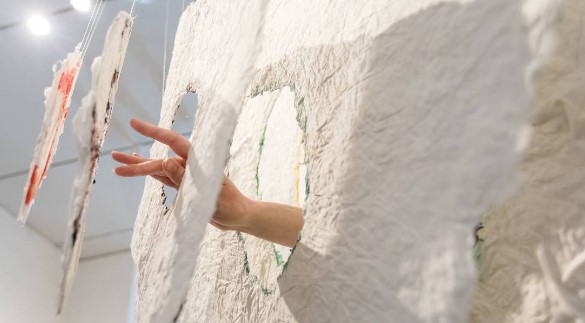
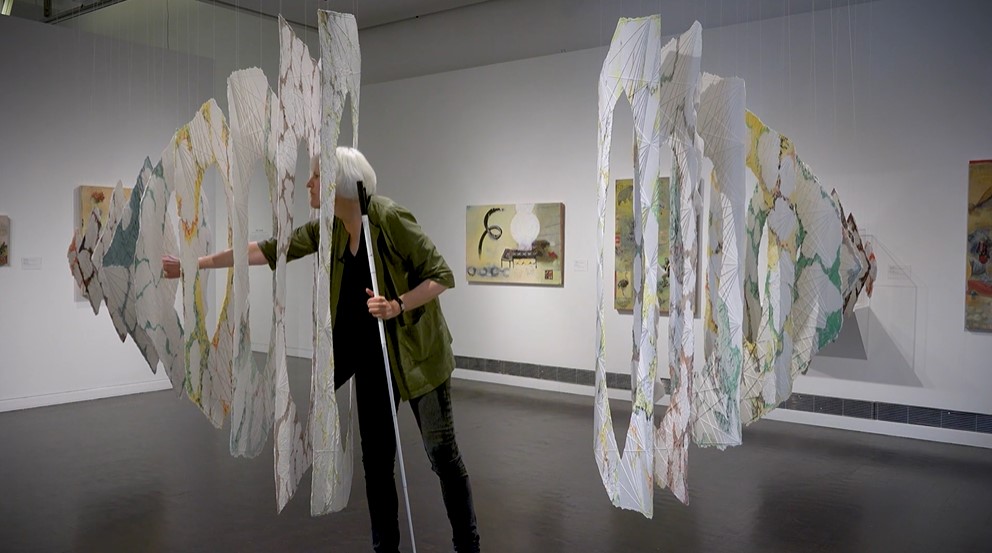
An image compilation features two film stills from a video produced by the Contemporary Jewish Museum about an artistic exhibit titled, “Haptic Encounter by Georgina Kleege with work by Julia Goodman” (2017-18). In the first image, a hand reaches through a small tunnel of layered, textured paper that hangs from fishing line adhered to the museum ceiling. The subsequent image features Georgina Kleege, a professor in the English and Disability Studies departments at UC Berkeley. Kleege has white hair, wears a green shirt, and holds a white cane in her left hand as she reaches her right hand through the the hanging paper tunnel of this interactive, tactile exhibit. IMAGE REFERENCE: Contemporary Jewish Museum. (2018). Haptic Encounter by Georgina Kleege with work by Julia Goodman [film stills]. Video by Laurie Lezin-Schmidt. Photos by Gary Sexton Photography.
THRESHOLD CONCEPT:
vision/visuality (n.): a central area of concern in Disability Studies scholarship that focuses on disability representations, cultural constructions of blindness, notions of in/visibility, symbolic markers of disability, and portrayals of disability in popular culture [1]
Click “play” to access an auditory transcription of the following webtext (Part III), as written and read by Rachel Rubino.
Part I of this project explains how concept maps are commonly used to visually depict different information sets and categorize those distinctions into graphical constructions called “nodes.” The concept map, when taken up as a visual tool, necessitates a hierarchical framework of organization that the user typically works from to distinguish connections between nodes. This type of structure is usually implemented as a design strategy and accessible measure for sighted individuals. The visual emphasis of this prototypical model can ease the cognitive loads of creators and consumers alike as they use concept maps to discern connections between discrete units of information (Harter & Ku, 1670) [2].
Certainly, the hierarchical structure of these visual concept maps helps many users distill comprehensible approaches toward dealing with complex concepts. Nevertheless, literature that explicitly outlines alternative approaches to concept mapping remains scant. While researchers across professional, STEM and humanities-based fields embrace concept maps as a beneficial tool for teaching and learning, there remains much opportunity to embrace the full potential scope of this pedagogical tool.
According to the Keywords for Disability Studies essay on “Visuality” (2015) by Georgina Kleege, the act of visualizing and the process of visualization are culturally entangled with knowledge-making. Kleege notes how, “it was Thomas Carlyle who coined the noun ‘visuality’ as well as the verb ‘visualize’ in 1841, to refer to qualities related to making mental images of abstract ideas… In recent decades, visuality has…taken on additional nuances of meaning” (182). As Kleege reasons, western society has come to acknowledge visuality in terms akin to the process of actualizing knowledge. This emphasis has culminated in a binary construction to which blindness stands for ignorance, or the distinct lack of ability to acquire knowledge.
Kleege captures the essence of this polarity within her remarks upon “blind” and “blindness” as terminologies that continue to influence debate between contemporary academics and activists. “Because the word ‘blind’ is so often used figuratively to mean ignorant, prejudiced, or oblivious, some scholars insist on terms such as ‘visually impaired,’ or ‘people with vision impairments’ or ‘people with visual disabilities,’” she explains (184). By acknowledging disability visuality as a cultural construction, we are primed to consider the role that visuality plays in normative models of concept maps.
Standardized models of knowledge production and dissemination evidence a visual predominance hinged upon the norms of concept map models as well as concept mapping approaches. Tara Shankar suggests a framework for this visual predominance within her remarks upon the hierarchy between written and spoken forms of language. This hierarchy finds its footing within the popularization of modern writing technologies. In effect, “reading and writing have become the predominant way of acquiring and expressing intellect in Western culture” (Shankar, 374). Since the development of modern print technology, visual models of writing have been valued over alternative approaches to knowledge production like that of speeches, conversational dialogue, or other expressions of orality. I call attention to this dichotomy as most visual concept maps utilize writing in some way.
Shankar’s scholarship is purposeful to this project, as she surveys the convergence between knowledge and technology. She contends that,
“the ability to write has become completely identified with intellectual power, creating a graphocentric myopia concerning the very nature and transfer of knowledge. One of the effects of graphocentrism is a conflation of concepts more proper to knowledge in general with concepts specific to written expression” (374).
Shankar’s assertion sheds light upon our previous investigations of concept maps. If concept maps are used to create and share knowledge, then a culture entrenched in “graphocentric myopia” is a culture that opts to convey knowledge by using written (ie: visual) techniques. Ultimately, this systemic approach has reinforced seeing as an act of knowing at a detriment to alterative models that could comprehensively address diverse modes of meaning-making.
At the conclusion of her keyword essay, Kleege specifically alludes to mapping at the juncture of auditory and tactile measures. She indicates how contemporary scholars are positioned to consider the senses of sound and touch as they think about representation for blind users. Kleege contends that, “producers… will soon be required to provide access to people with visual disabilities, through such practices as audio description, tactile drawings and diagrams, and global positioning devices, and we can expect that disability scholars will critique how these standards are implemented” (184). With Kleege’s assertion in mind, I am prompted to evaluate how visually rendered concept maps are designed to synthesize and portray information.
How might the norm of visuality potentially overshadow ways of knowing informed by other alternative sensory experiences? How then might alterative types of concept maps disclose information, convergences, and patterns that visual concept maps may neglect or otherwise fail to acknowledge? Would an emphasis on auditory or tactile processing help concept mappers identify implications or recognize biases that were otherwise obscured by the visual emphasis of traditional concept maps?
[1] The paraphrased definition of this threshold concept is drawn from Kleege’s keyword essay on “Visuality” (2015). See “References” to access an extended citation of this source.
[2] To support this research, Harter and Ku cite Mayer and Moreno, whose Journal of Educational Psychology article on “[…] dual processing systems in working memory” (1998) identifies “selecting and organizing”—two tasks common to visual concept mapping—as those which “depend on internal cognitive processing and are subject to working memory limitations” (1670, as paraphrased in Harter & Ku). Harter and Ku extend this point to consider the spatial contiguity principle. See “References” to access extended citations of both aforementioned sources.

 Charting the Crossroads of Knowledge and Making: Concept Maps as Rhetorical Sites of Transformative Access